
Wall-Hung vs. Floor-Mounted: How to Specify Vanities, Toilets, Linen Cabinets and Basins for the High-End Bathroom

A specifier’s guide to wall-hung and floor-mounted bathroom fixtures, considering aesthetics, resale value, upkeep, ease of cleaning, timeless design, and cost, with European examples from Alice Ceramica, Berloni Bagno, and JEE-O.

Berloni Pura Base Cabinet in Dark Oak 
JEE-O Flow Bath Faucet Freestanding Bath Faucet in Brushed 
BH Portofino Cupboard 1 Door 45" Tall in Walnut 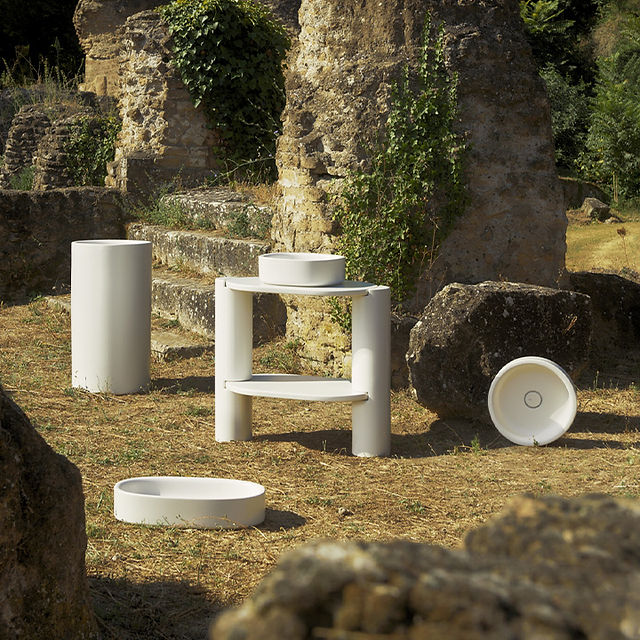
Alice IDILLA Collection 
BH Portofino Base Unit in Green Matte 
ALICE IDILLA BTW Toilet in Matte White
Few decisions shape the feel of a bathroom as quickly as where its fixtures meet the architecture. A vanity that floats above the floor reads as light and continuous. A basin rising from the floor like a column reads as sculpture.
The choice between wall-hung and floor-mounted is made early, often before finishes are selected, and it sets the terms for framing, plumbing, cleaning and the way a client will experience the room for years.
This guide looks at both approaches through the lens that matters most to high-end homebuyers: aesthetics, resale value, maintenance, ease of cleaning, timelessness and cost. Every product example referenced is available through Pontem Home.
The short answer: Wall-hung fixtures suit contemporary, European-influenced bathrooms where an open floor, easy cleaning and adjustable mounting height are priorities, and where the wall can be framed and reinforced during construction. Floor-mounted fixtures suit spaces where a sculptural, grounded presence is the design intent, or where the wall structure or existing plumbing favors a floor connection. Many of the most considered bathrooms combine both.
Key takeaways:
Wall-hung fixtures keep the floor plane continuous, which visually enlarges the room and simplifies cleaning.
Wall-hung toilets and bath furniture depend on planning inside the wall: in-wall carriers, blocking and plumbing positions should be coordinated before drywall.
Floor-mounted pieces, such as freestanding basins and floor-standing faucets, bring a sculptural, architectural presence to larger rooms.
Timelessness comes less from the mounting method and more from proportion, material and design details.
Cost is best evaluated as total installed investment, including carriers, framing and trade coordination, rather than fixture price alone.
What is the difference between wall-hung and floor-mounted fixtures?
A wall-hung (or wall-mounted) fixture is supported by the wall structure, leaving open space between the piece and the floor. For toilets, that support typically comes from an in-wall carrier that also conceals the tank. For vanities and linen cabinets, it comes from secure fixing into reinforced framing.
A floor-mounted fixture is supported by the floor. In luxury bathrooms, this category extends well beyond the traditional toilet and cabinet: it includes freestanding washbasins, floor-standing baths and basin faucets, and freestanding shower columns that stand in the room as objects in their own right.
Wall-hung vs. floor-mounted at a glance:
Criterion | Wall-hung | Floor-mounted |
Aesthetics | Floating, linear, contemporary. The floor reads as one uninterrupted surface. | Grounded and sculptural. Pieces read as architecture or furniture within the room. |
Resale appeal | Aligns with the clean, European-influenced look many buyers associate with new, design-led homes. | Freestanding statement pieces can become a memorable signature of the home. |
Maintenance | Easy access to the in-wall carrier and flush mechanism through the actuator plate. | Service connections are typically accessible at or below floor level. |
Ease of cleaning | Open floor beneath allows a continuous sweep and mop. | Clean around the base; freestanding forms in glazed ceramic wipe down easily. |
Timelessness | Reads as enduring when paired with restrained forms and quality finishes. | Column and pedestal forms have deep roots in bathroom design history. |
Cost planning | Budget for in-wall carrier, reinforced framing and coordination time. | Budget for floor drain or supply routing, especially for freestanding pieces. |
Best suited to | New builds, full renovations, compact rooms, contemporary schemes. | Larger primary baths, statement layouts, spaces where the wall structure favors floor support. |
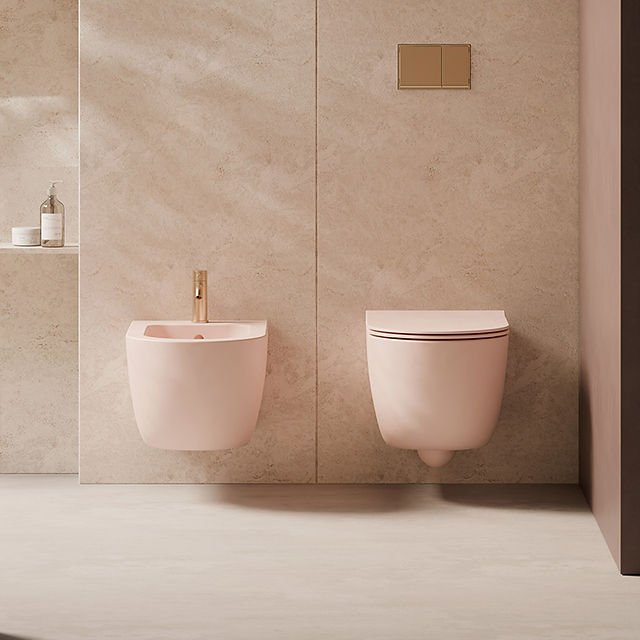
ALICE FORM Toilet Wall Hung in Rose Matte 
ALICE NUR Toilet Wall Hung in Green Matte 
ALICE IDILLA Toilet Wall Hung in Myrtle Blue Gloss 
ALICE NUR BTW Toilet in Myrtle Blue Gloss 
ALICE IDILLA BTW Toilet in Matte White 
ALICE IDILLA BTW Toilet in Matte Grey
Toilets: wall-hung vs. floor-mounted
Why specifiers choose wall-hung toilets:
A wall-hung toilet is often the first fixture a designer reaches for in a contemporary bathroom, and for good reason. With the tank concealed and the bowl lifted off the floor, the room gains visual depth and the floor finish can run uninterrupted from wall to wall.
Alice Ceramica's NUR wall-hung toilet and FORM wall-hung toilet show how much design can live in a single piece of sanitaryware. Both are rimless and fully skirted, which simplifies cleaning, and both carry Ali Glaze, Alice's antibacterial glaze for a smoother, shinier surface. The IDILLA wall-hung toilet offers a softer, more classical expression of the same mounting approach.
What to plan for:
Carrier coordination. Alice wall-hung toilets are sold as the bowl only and pair with a Geberit in-wall carrier and flush plate, which is sourced separately. Confirm the carrier, actuator and fixing hardware during specification process.
Acoustic detailing. Alice offers optional sound protection for wall-hung toilets, recommended to absorb sound between the tiled wall and the toilet.
Seat selection. Soft-close seats such as the NUR seat and FORM seat are specified separately, with finishes that match the ceramic colors.
When floor-mounted toilets make sense:
Floor-mounted and back-to-wall toilets remain a considered choice in renovations where opening the wall is not planned, or where the floor connection is already set. The NUR and FORM collections are designed to work in both configurations: their soft-close seats pair with floor-mounted and wall-mounted versions, and Alice offers a fixing set for back-to-wall toilets. This lets a design team keep one visual language across a home, even when different rooms call for different mounting methods.

Berloni Pura Base Cabinet in Dark Oak 
Berloni Vintage Base Cabinet in Matte Black 
BH Idra Base Unit in Oak Tobacco 
BH Roma Base Cabinet Unit in Matte White 
BH Portofino Base Unit in Green Matte 
Berloni Vintage Base Cabinet in Gloss Felce
Vanities: floating cabinetry vs. grounded presence
The case for wall-mounted vanities:
Wall-mounted vanities give designers control over height, which matters for tall clients, accessible layouts and double-vanity primaries where each user may prefer a different working height. They also keep the floor clear for radiant heat, continuous tile and robotic or traditional cleaning.
Berloni Bagno's modular cabinetry is built around this approach. The Suite base cabinet 24" and Suite base cabinet 36" are wall-mount units with Blum soft-closing drawers, premium MDF construction and a hand-applied lacquer in gloss or matte, made to order in Italy. For warmer, more tactile schemes, the Pura base cabinet pairs an oak fluted veneer front, also designed for wall mounting.
Getting the grounded look with a wall-mounted structure:
Some clients love the proportion of furniture on legs but want the cleaning and structural benefits of a wall-hung unit. Berloni resolves this elegantly. The Prisma leg, a handmade lacquered MDF leg 14" in height, pairs with two-drawer Suite and Vintage base units. The legs are aesthetic, and the base unit is still mounted to the wall, so the piece reads as furniture while performing as floating cabinetry.
Baden Haus approaches the same question from the side of everyday function. The Roma base cabinet is a wall-mount unit with soft-closing slim metal slides, glass dividers and a black interior, built in MDF with a Foil finish that resists moisture and scratches, and offered in compact widths for powder rooms; see the Roma collection. The Idra base unit brings push opening and soft closing to a design of soft curves. Where a project calls for a grounded, furniture-like piece, the Portofino collection is defined by a thin solid wood leg that continues the line of the cabinet, with a fine fluted effect on the fronts and sides, and is also offered wall-mounted.
For a broader look at how Berloni Bagno, Baden Haus and Alice Ceramica each approach vanity design, see Pontem's comparison of luxury Italian bathroom vanities, or browse all vanity base units.
What to plan for:
Blocking. Specify solid backing at the correct height before the wall is closed, sized to the full cabinet width.
Storage volume. A floating vanity trades some lower storage for floor space. Tall linen cabinets or mirrored cabinets can balance the storage plan.
Plumbing position. Supply and waste lines should be located to suit drawer internals, since many wall-hung units use drawers rather than doors.

BH Portofino Cupboard 1 Door 45" Tall in Walnut 
Berloni Vintage 1 Door 14" Column in Gloss Pebble Grey 
BH Idra Linen Cabinet 48" with Fluted Design in Walnut
Linen cabinets and tall storage:
Tall storage is where the wall-hung approach earns its keep in a primary bath. A floating column keeps the floor line consistent with the vanity and avoids a heavy block of cabinetry at floor level.
Berloni's Suite column and Vintage column are 14" linen cabinets with one fixed shelf and four adjustable glass shelves, handle-free push-to-open doors, and hand-lacquered MDF in more than 100 gloss or matte lacquered finishes. Both are wall-mounted and made to order in Italy, which allows the column to align precisely with a matching base unit for a coordinated elevation.
Baden Haus offers tall storage in the same design families as its vanities, including the fluted Idra linen cabinet, which is wall-mounted, and the Portofino tall cupboard, so the elevation reads as one composition.
Specifier tip: Align the bottom of the column with the bottom of the vanity, or deliberately offset it, but decide early. That single line does a great deal to make a wall of cabinetry feel intentional.

ALICE SPY Basin 40" x 18" PLAN in Pine Green Gloss 
Alice IDILLA Collection 
ALICE IDILLA Basin Freestanding 18" Round in Laguna Matte
Washbasins: wall-hung, countertop and freestanding:
Basins offer the widest range of mounting expressions. A wall-hung basin creates a minimal, floating plane. A freestanding basin becomes the focal point of the room.
Alice Ceramica's SPY basin 40" x 18" PLAN is a ceramic basin with an integrated overflow, available in matte and gloss, made in Italy. It can be wall-mounted with the FIX 01 fixing kit, giving a clean, cantilevered profile with no cabinet below.
At the other end of the spectrum, the IDILLA freestanding 18" round basin rises from the floor as a single ceramic form. It is offered with a floor drain, or in an open version with a wall drain, which gives the design team flexibility depending on where the waste line can run. Explore every mounting type on Pontem's bathroom sinks page.

JEE-O Slimline Basin Faucet floor Freestanding in Bronze 
JEE-O Flow Shower 02 Freestanding Shower Faucet in Brushed 
JEE-O Flow Bath Faucet Freestanding Bath Faucet in Brushed 
JEE-O Flow Basin Faucet (LH) Wall with integrated Towel Bar in Brushed 
JEE-O Bloom Bath Faucet Freestanding Stainless Steel with Hand Shower in Gun Metal
Faucets and showers: floor-standing vs. wall-mounted:
The same choice applies to brassware and, increasingly, to stainless steel. A floor-standing faucet beside a freestanding tub or basin extends the sculptural language of the room. A wall-mounted faucet keeps surfaces clear and lines crisp.
JEE-O, crafted in stainless steel, offers both. The Bloom freestanding bath faucet with hand shower is made in r304 stainless steel with a PVD-coated Gun Metal finish. The Flow freestanding basin faucet and Slimline floor-standing basin faucet pair naturally with freestanding basins, and the Flow Shower 02 brings the same freestanding approach to the shower.
On the wall-mounted side, the Flow wall basin faucet with integrated towel bar combines two functions in one continuous stainless steel line.
How each option performs against what high-end buyers value
Aesthetics
Wall-hung fixtures create lightness and continuity, and they suit minimalist, modern European and spa-inspired rooms. Floor-mounted statement pieces create focus and a sense of permanence. In practice, the strongest rooms often use wall-hung toilets and cabinetry to quiet the perimeter, then place a single tub as the focal point.
Resale appeal
Buyers in the luxury market tend to respond to bathrooms that feel designed rather than assembled. Wall-hung fixtures signal a considered, clean, contemporary build, while a well-chosen freestanding piece gives the room a memorable identity. Consistency matters as much as the mounting method: a coordinated collection across the bathroom reads as intentional.
Maintenance
Wall-hung toilets keep the flush mechanism behind the wall, with service access typically through the actuator plate, so documenting the carrier model for the homeowner is good practice. Floor-mounted fixtures generally keep connections accessible at or below floor level. For cabinetry, soft-closing drawer systems such as Blum, used in Berloni's Suite and Speed ranges, support smooth daily use over time.
Ease of cleaning
This is where wall-hung fixtures are hardest to beat. An open floor allows a continuous sweep, and rimless, fully skirted bowls such as Alice's NUR and FORM simplify cleaning of the fixture itself. Freestanding ceramic forms are also straightforward to maintain, since glazed ceramic wipes clean and has no seams at the countertop.
Timelessness
Neither approach is tied to a single decade. Wall-hung fixtures have been a European standard for many years, and column and pedestal forms reach much further back. What keeps a bathroom enduring is proportion, material honesty and restraint: glazed ceramic, stainless steel, hand-applied lacquer and natural wood veneer all hold their character over time.
Cost
Evaluate total installed investment rather than fixture price alone. Wall-hung toilets require an in-wall carrier and reinforced framing, and wall-hung cabinetry requires blocking. Freestanding basins and floor-standing faucets require floor routing for supply and, in some cases, waste. On new construction and full renovations, these requirements are simply part of the rough-in plan. On partial renovations, they can shape which option makes the most sense. For project-specific trade pricing and lead times, contact the Pontem team.
Which should you specify? A quick decision guide
If the project... | Consider | Why |
Is new construction or a full gut renovation | Wall-hung toilets and cabinetry | Carriers and blocking fit naturally into the rough-in. |
Has a compact footprint | Wall-hung throughout | A visible floor makes the room feel larger. |
Is a large primary bath | A mix, with one freestanding focal piece | Quiet perimeter, sculptural center. |
Must keep existing walls closed | Floor-mounted or back-to-wall toilet | Works with existing connections. |
Needs custom counter heights | Wall-mounted vanity | Mounting height is set per user. |
Calls for a furniture look | Wall-mounted base with decorative legs | Grounded silhouette, floating performance. |
Frequently asked questions
Are wall-hung toilets strong enough for everyday use?
Yes, when installed on a properly rated in-wall carrier and fixed into correctly prepared framing. Alice wall-hung toilets pair with a Geberit in-wall carriers which are16-gauge, powder-coated, structural steel tubing on the carrier rated to support up to 880 lbs. (400 kg) without damage to finished wall or carrier unit.
Do wall-hung toilets need a special carrier?
Yes. Alice Ceramica wall-hung toilets are supplied as the bowl only; the in-wall carrier, seat and fixing screws are specified separately.
Is a floating vanity easier to clean than a floor-standing one?
Generally, yes. The open floor beneath allows a continuous sweep and mop, with no base or toe kick to clean around.
Should a vanity with legs still be wall-mounted?
Depends on the unit and the height of the legs. Berloni's Prisma legs are only decorative and pair with two-drawer Suite and Vintage base units, which remain mounted to the wall.
Do floating fixtures add value to a luxury home?
Floating fixtures align with the contemporary, European-influenced look many high-end buyers seek. Overall design quality and consistency across the home tend to matter as much as any single choice.
Where can I find wall-hung and freestanding European bathroom fixtures in the US?
Pontem Home is the US distributor for Alice Ceramica, Baden Haus, Berloni Bagno, JEE-O, and other European brands, with trade accounts offering access to pricing, specifications and ordering. Browse the full brand roster or download the 2026 Pontem Home catalog.
Designing from the wall out
The mounting decision is ultimately a design decision. Wall-hung fixtures let the floor, light and materials carry the room. Floor-mounted pieces let a single object hold it. Whichever direction a project takes, the details inside the wall and beneath the floor are what allow the finished space to feel effortless.
Explore the collections at from Alice Ceramica, Baden Haus, Berloni Bagno and JEE-O at Pontem Home.
Browse the full brand roster and contact our team to discuss specifications
for your next project.


Comments