
Wall-Hung vs. Floor-Standing Bathroom Furniture: Pros, Considerations and How 3 Italian Brands Approach Each

Wall-hung or floor-standing vanity? A specifier's comparison of aesthetics, resale appeal, maintenance, cleaning, timelessness and cost, with examples of each from Berloni Bagno, Baden Haus and Alice Ceramica.

Alice Ceramica Console in Black Matte 
Berloni Pura Base Cabinet in White Oak 
Berloni Way Round Base Cabinet 2 drawers in Wood Natura 
BH Idra Base Unit 1 Drawer in Green Matte 
ALICE SPY Basin 40" x 18" in Grey Matte 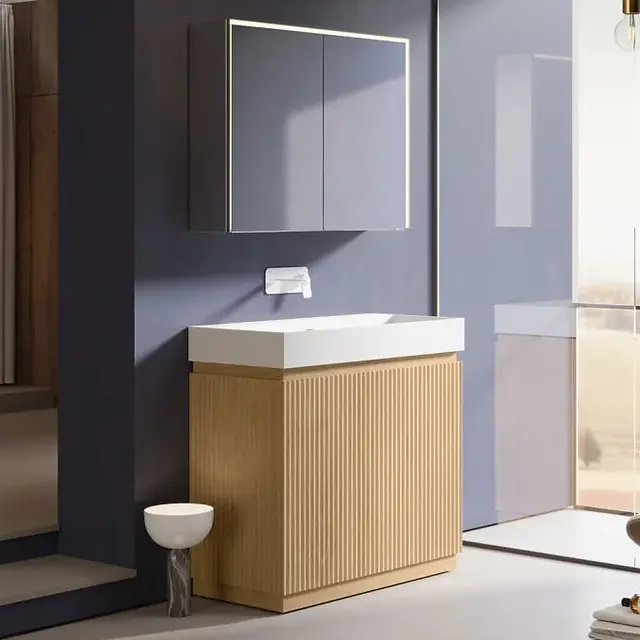
BH Roma Base Cabinet Unit in Tobacco Oak
Before a finish is chosen or a basin is selected, every vanity starts with one quiet decision: does it float, or does it stand? That choice sets the tone of the room. It decides how the floor reads, how the wall is framed, how much storage sits below the counter and how the piece will feel to live with every day.
This guide compares wall-hung and floor-standing vanities through the criteria high-end homebuyers care about most: aesthetics, resale appeal, maintenance, ease of cleaning, timelessness and cost. It then shows how three Italian brands available through Pontem Home - Berloni Bagno, Baden Haus and Alice Ceramica - interpret each approach.
The short answer: A wall-hung vanity suits contemporary and European-influenced bathrooms where a visible floor, easy cleaning and a custom counter height matter most, and where the wall can be reinforced during construction. A floor-standing vanity, whether on legs, feet or a sculptural base, suits rooms where the vanity should read as furniture or as a focal object. Several Italian collections now offer both expressions within the same design family, so the decision can follow the room rather than the catalog.
Key takeaways:
Wall-hung vanities keep the floor plane continuous, which makes a bathroom feel larger and simplifies cleaning.
Floor-standing vanities read as furniture, with legs, feet or a sculptural base that gives the piece presence and proportion.
Hybrid designs pair a wall-mounted cabinet with decorative legs, delivering a furniture silhouette with floating-vanity performance.
Berloni Bagno, Baden Haus and Alice Ceramica each offer a wall-hung and a leg-supported or freestanding expression, in very different design languages.
Cost is best compared as total installed investment: wall blocking for wall-hung units and added leg or foot components for grounded designs.
What is the difference between wall-hung and a floor-standing bath furniture?
A wall-hung vanity (also called wall-mounted or floating vanity) is fixed to the wall, with open space between the cabinet and the floor. Its weight is carried by the wall structure, which is why solid backing is planned before the wall is closed.
A floor-standing vanity or console (also called floor-mounted or freestanding vanity or console) meets the floor through legs, feet, a plinth or a sculptural base. In European design, this category is broad. It includes furniture-style cabinets on slender legs, ceramic consoles and freestanding basins that rise from the floor as a single form.
Between the two sits a hybrid: a wall-mounted cabinet paired with legs. The legs complete the silhouette, while the wall does the structural work. Several of the collections below use this approach, so it is worth confirming how each legged unit is supported before finalizing drawings.
Wall-hung vs. floor-standing vanities at a glance:
Criterion | Wall-hung | Floor-standing |
Aesthetics | Floating, linear and architectural. The floor runs uninterrupted beneath. | Furniture-like or sculptural. Legs and bases add proportion and presence. |
Resale Appeal | Signals a contemporary, design-forward, European-influenced build. | Gives the bathroom a distinctive, crafted identity that buyers remember. |
Maintenance | Plumbing is easily accessible as in fully exposed or accessed by removing a drawer. | Leg-supported units keep plumbing visible and/or easily reachable; enclosed bases conceal it. |
Ease of cleaning | Open floor allows a continuous sweep and mop. | Slender legs leave most of the floor open; clean around each leg or base. |
Timelessness | A long-standing European standard with an enduring, restrained profile. | Draws on the long history of freestanding furniture and washstands. |
Cost planning | Budget for wall blocking and installation time. | Budget for leg or foot components and any added fixing hardware. |
Wall-hung vanities: pros and considerations
Pros
Visual space. With the floor visible beneath the cabinet, the room reads larger and calmer, which matters in powder rooms and compact en suites.
Continuous floor finish. Large-format tile, stone and radiant floor heating can run wall to wall.
Custom counter height. The installer sets the mounting height, so a tall client or a double vanity with two working heights is easy to accommodate.
Cleaning. Nothing meets the floor, so the space below can be swept in one pass.
Modularity. Wall-hung systems often combine base units, side cabinets and tall linen cabinets on a shared line, creating a coordinated elevation.
Considerations
Wall preparation. Solid backing sized to the full cabinet width should be installed before drywall.
Storage volume. Lifting the cabinet off the floor trades some lower storage for open floor. Tall linen cabinets or side units can balance the storage plan.
Plumbing coordination. Supply and waste lines should be positioned to clear drawer internals, since many wall-hung units use full-extension drawers.
Floor-standing vanities: pros and considerations
Pros
Furniture character. Legs and feet give a vanity the proportion of a crafted piece, which suits transitional, classic and warm modern interiors.
Sculptural possibility. Ceramic consoles and freestanding basins turn the vanity into the focal point of the room.
Visual lightness on legs. Slender legs keep most of the floor visible, preserving much of the openness of a floating design.
Grounded presence in larger rooms. In a generous primary bath, a floor-standing piece can anchor the space in a way a floating unit may not.
Considerations:
Fixed height. Counter height is largely set by the leg or base dimension, so confirm it against the client's preference early.
Structural support. Some legged collections are designed to be wall-mounted as well. Confirm the fixing requirements for each unit.
Floor layout. Legs and bases sit on the finished floor, so coordinate their positions with tile layout and any floor drains.
Additional components. Legs and feet are often specified as separate line items.
How Berloni Bagno, Baden Haus & Alice Ceramica Approach Each Style
Each of the three Italian brands at Pontem interprets the floating and floorstanding vanity in its own language. For a broader look at how the three brands differ, see Pontem's comparison of luxury Italian bathroom vanities.
Brand | Wall-hung expression | Floor-standing or grounded expression |
Berloni Bagno | Suite, Pura and Way Round wall-mount base cabinets | Suite Vintage base with Prisma legs (decorative legs on a wall-mounted cabinet) |
Baden Haus | Idra wall-mount base units | Roma Vanity and Portofino with solid wood legs |
Alice Ceramica | SPY ceramic basin, wall-mounted | IDILLA ceramic console with legs; IDILLA freestanding basin |

Berloni Vintage Base Cabinet 42" 2 drawers in Malta 
Berloni Pura Base Cabinet in Dark Oak 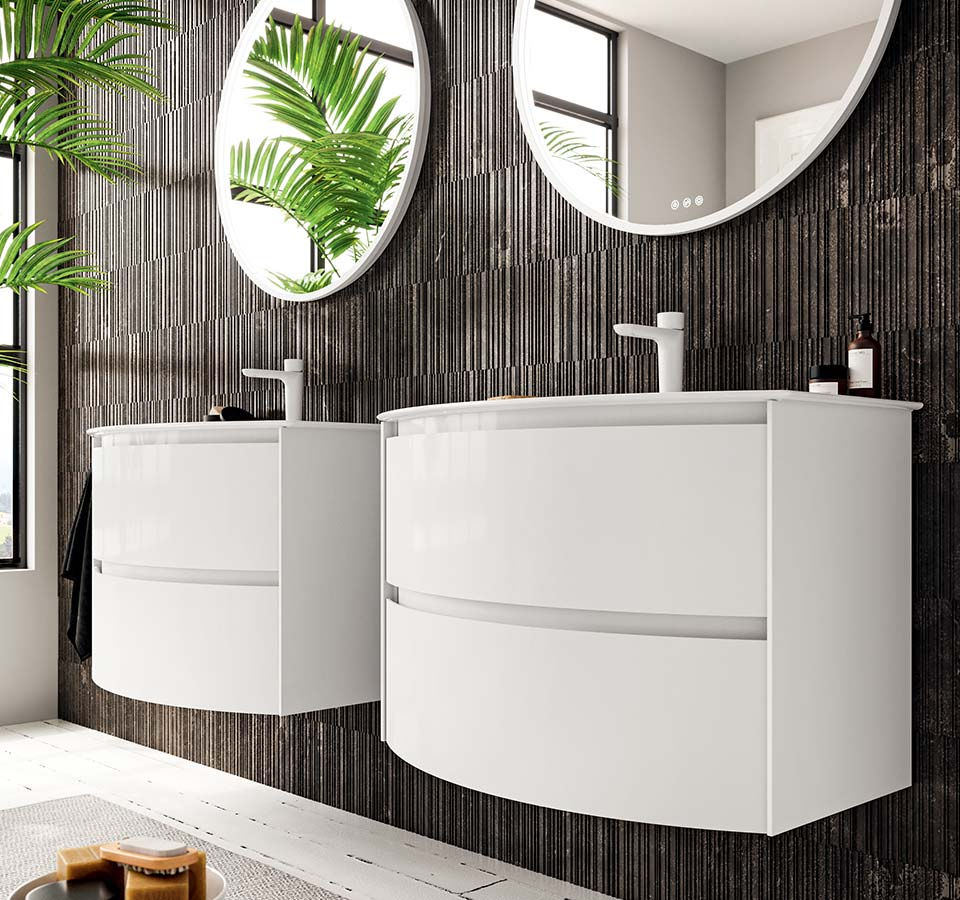
Berloni Way Round Base Cabinet 2 drawers in White Gloss
Berloni Bagno: architectural precision, floating or grounded
Berloni Bagno produces its collections in Fossombrone, Italy, where design, raw material processing, lacquering and final assembly take place under one roof. Its wall-hung cabinetry is built for designers who want a tailored, architectural result.
Wall-hung: The Suite base cabinet 36" and Suite base cabinet 42" are wall-mount units with Blum soft-closing drawers, premium MDF construction and a hand-applied lacquer in gloss or matte, made to order in Italy. For a warmer, tactile look, the Pura base cabinet combines a fluted oak veneer front, and the Way Round base cabinet offers a two-drawer Blum system in a bow front vanity silloughette.
Grounded look: The Suite Vintage base cabinet 28" can be paired with the Prisma leg, a handmade, lacquered MDF leg 14" in height. Berloni notes that the legs are aesthetic and the base unit must still be mounted to the wall. The result is a furniture silhouette that performs like a floating vanity, with the same wall-fixed stability and open floor between the legs.

BH Idra Base Unit 1 Drawer in Oak Tobacco 
BH Portofino Base Unit in Black Matte 
BH Idra Linen Cabinet 48" with Fluted Design in Green Matte
Baden Haus: 1 design language, 2 ways to stand
Baden Haus, founded in 1979 in Ascoli Piceno, Italy, pairs Italian design with practical, everyday organization. Its collections make it easy to carry one look across rooms with different mounting needs.
Wall-hung: The Idra base unit brings the same organization to a design defined by soft curves, with push opening and soft closing.
Floor-standing: The Roma base cabinet is a freestanding unit with 2 concealed soft closing drawers, glass dividers and a dark interior, built in MDF with a PVC foil finish that resists moisture and scratches. Roma offers multiple sizes, including a 20" width save spacer unit perfect for small bathrooms, Explore the Roma collection.
The Portofino collection is defined by refined fluted cabinet with optional wood leg (choose either 2 or 4 legs) that continues the line of the cabinet. Drawers use the Blum hinge system with push opening and soft closing, and the collection is also offered wall-mounted without legs. Idra, too, can be specified with optional feet or kept floating, and pairs with the fluted Idra linen cabinet for a coordinated elevation.

ALICE SPY Basin 40" x 18" PLAN in Green Matte 
Alice Ceramica Console in Grey Matte 
ALICE IDILLA Basin Freestanding 18" Round in Sand Matte
Alice Ceramica: sculptural bathrooms furniture
Alice Ceramica, based in Civita Castellana, Italy, since 1998, treats bathroom furniture as an extension of its ceramic craft. Its consoles and basins are lighter and more expressive than traditional cabinetry.
Wall-hung: The SPY basin 40" x 18" PLAN is a ceramic basin with an integrated overflow, available in matte and gloss and made in Italy. Mounted to the wall with the FIX 01 kit, it creates a clean, cantilevered counter with nothing beneath. A matching towel bar is available separately.
Floor-standing: The IDILLA console is built from ceramic components, including IDILLA console shelves and IDILLA console legs, offered in the same broad palette as Alice's 15 ceramic sanitaryware finishes, from White Gloss and Black Matte to Sand Matte, Honey Gloss and Myrtle Blue Gloss. For a single sculptural gesture, the IDILLA freestanding 18" round basin rises directly from the floor and is offered with openings for a wall drain or enclosed to allow you to run the plumbing through the floor.
How each approach performs on what high-end buyers value
Aesthetics
Wall-hung vanities read as functional architecture: a clean horizontal line that lets the floor, tile and light lead. Floor-standing vanities read as furniture or sculpture. Portofino's solid wood legs and Alice's ceramic consoles show how a grounded vanity can still feel light, while a Berloni Suite Vintage on Prisma legs shows how a floating structure can take on a more classic look.
Resale value
High-end buyers tend to respond to bathrooms that feel designed rather than assembled. A floating vanity is one of the clearest cues of a contemporary, European-influenced build. A crafted, legged or ceramic piece gives the room a memorable identity. Whichever direction you choose, coordinating collections across every bathroom in the home strengthens the impression of quality.
Maintenance
Both approaches benefit from quality hardware. Soft-closing drawer systems, such as the Blum mechanisms used by Berloni and in Baden Haus, support smooth daily use over time. With a wall-hung or leg-supported vanity, plumbing is easy to reach from below. Glazed ceramic, as used by Alice, is antimicrobial and simple to care for, and the Baden Haus Roma and Idra use a PVC finish that resists moisture and scratches.
Ease of cleaning
Wall-hung vanities lead here, because nothing meets the floor. Slender-legged designs come close, leaving most of the floor open with only a few contact points to clean around. Freestanding ceramic forms wipe down easily and have no seams where a cabinet meets a counter.
Timelessness
Neither approach belongs to a single decade. The floating vanity has been a European standard for many years and remains a favorite for a spa-like bathroom design. Longevity comes from proportion and material: hand-applied lacquer, natural wood veneer, solid wood legs and glazed ceramic all hold their character over time.
Cost
Quality pays off over time. Invest in a quality vanity built to perform, last, and look great for years. Well-made products deliver more value with every day of use. Custom made-to-order vanities, such as Berloni's lacquered collections have lead times worth building into the new construction or remodeling schedule. For trade pricing and current lead times, contact the Pontem team.
Specifier checklist:
Decide between floating, grounded or hybrid before framing, and install solid backing wherever a cabinet will be wall-fixed.
Confirm whether each legged unit is self-supporting or also requires wall mounting.
Set counter height early. For wall-hung units, record the mounting height on drawings; for legged units, confirm the leg dimension.
Coordinate supply and waste positions with drawer internals and, for freestanding basins, with the floor or wall drain version selected.
Plan tall storage alongside the vanity, such as the Idra linen cabinet or Portofino tall cupboard, so the elevation reads as one composition.
Review local code requirements.
Which vanity should you specify?
If the project... | Consider | Why |
Is a compact bath or powder room | Wall-hung Sink or Vanity | Exposed floor makes the room feel larger. |
Needs a custom counter height | Wall-hung (Berloni Suite) | Height is set at installation. |
Calls for a warm, furnished look | Legged (Baden Haus Portofino) | Solid wood legs give furniture proportion. |
Wants a furniture look with floating performance | Hybrid (Berloni Suite Vintage with Prisma legs) | Legs complete the look; the wall carries the load. |
Needs a statement in a guest bath or hotel suite | Ceramic (Alice IDILLA console or freestanding basin) | The vanity becomes the focal object. |
Mixes mounting types across the home | One collection, both ways (Portofino, Idra) | Keeps a single design language in every room. |
Frequently asked questions
Is a wall-hung vanity better than a floor-standing vanity?
Neither is better in every case. Wall-hung vanities excel at visual space, cleaning and custom height. Floor-standing vanities bring furniture character and sculptural presence. The right choice depends on the room, the design intent and the construction plan.
Are wall-hung vanities strong enough for heavy stone or ceramic tops?
Yes, when fixed into properly prepared backing following the manufacturer's instructions. Plan the blocking before the wall is closed, sized to the cabinet and top.
Do vanities with legs need to be attached to the wall?
Some do. Berloni's Prisma legs, for example, are decorative, and the Suite Vintage base unit must still be wall-mounted. Confirm the fixing requirements for each collection.
Which vanity type is easiest to clean?
A wall-hung vanity, because the floor beneath is completely open. Vanities on slender legs are a close second.
Which vanity type works best in a small bathroom?
A wall-hung vanity or a compact console. Baden Haus Roma Vanity, offered in widths as narrow as 20", and Alice Ceramica Pedestals help small rooms feel open.
Can the same vanity collection be ordered wall-hung or with legs?
Yes, in several collections. Baden Haus Portofino is offered wall-mounted or with solid wood legs, and Idra can be specified with optional feet or floating.
Where can I see these vanities in person?
Pontem Home has a network of Berloni Bagno, Baden Haus and Alice Ceramica Dealers around the United States. Use Pontem's Dealer Locator to find the nearest showroom. Browse all vanities and consoles or contact our team to schedule a virtual tour of our Pontem Experience Center.
Floating or grounded, designed with intent
The best vanity is the one that suits the room it lives in. A floating cabinet lets the floor and light carry the space. A vanity on legs or a ceramic console gives the room a center of gravity. With Berloni Bagno, Baden Haus and Alice Ceramica each offering both expressions, the mounting decision can follow the architecture, while the design stays true to the client's vision.
Explore Berloni Bagno, Baden Haus and Alice Ceramica
at Pontem Home
Contact our team to discuss specifications for your next project.


Comments